
To prevent or remove or stop condensation, you need to remove one of the two factors that are causing the condensation. Condensation occurs when warm moist air comes in contact with a cold surface. Condensation can be prevented by either removing the warm moist air or removing the cold surface.
All air holds some moisture and the amount of moisture air can hold is dependent on temperature. Warm air can hold more moisture than cold air. The amount of moisture in air is compared to how much the air can hold and referred to as the relative % humidity. As a baseline, BRANZ recommends a relative humidity between 40-60%. When the relative humidity is too low, it can dry skin and nasal passages and can cause health problems. When the humidity is too high, it encourages mold growth, asthma, respiratory illnesses, condensation and eventually water damage.
It is important to understand how much moisture air can hold at different temperatures. For example, if room air at 60% relative humidity and 18 °C is cooled on a window then condensation will occur at only 9 °C (1). To prevent condensation, you must either remove moisture from the air OR ensure that your windows don’t reach 9°C.
If you use a dehumidifier (or DVS) to remove moisture, you can get the relative humidity at 18 °C down to the minimum for comfort at 40% and avoid condensation on windows all the way down to 4 °C. If windows get colder than 4 °C, you can still expect condensation even with the dehumidifier. Since reducing the humidity below 40 % can cause health problems, there are limits to how much moisture you should remove from the air to prevent condensation. In addition, a dehumidifier will also have to run often to keep the moisture content low because simple activities like breathing, cooking, and especially drying clothes inside introduce more moisture. A perpetually running dehumidifier will incur the continued cost of the electricity needed to run it in addition to the original dehumidifier purchase price.
There are also other disadvantages to only removing humidity but keeping the cold windows. Cold windows will remove heat from the warm air faster so you will have to continually introduce more heat into the air to keep the room at a comfortable temperature. This also requires energy, which is getting increasingly more expensive.
An alternative to the cost of continually removing moisture is to ensure that windows don’t get as cold. To do this, windows need to be chosen that have a higher resistance to heat transfer, or higher “R-Value”. A high R-Value window allows significantly lower heat to be transferred through the window. This will result in a much larger temperature difference between internal and external surface temperatures. For example, it can be -3 °C outside and the inside surface of a uPVC window can be 18°C in a room that is 22 °C (2). If the window surface never gets cold, it won’t produce condensation. A warm window will also not cool the room air so will also cost less energy to keep the room comfortable.
For a comparison, a standard single glazed aluminium window has an R-Value of 0.26. This is a relatively low number for a window. A ThermaScreen double glazed uPVC window with Low-E glass and argon fill (our standard window) has an R-Value of 0.65. This R-Value is 2.5X better than the single glazed aluminium window.
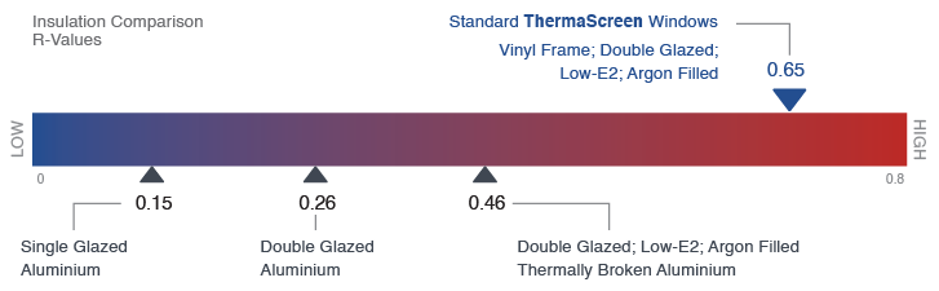
The relative values are a direct comparison of the amount of heat that will be transferred through the same window. This means that literally 2.5X more heat can be transmitted through a single glazed aluminium window than our standard double glazed uPVC window. That is also 2.5X more heat you will have pay for to keep your room comfortable. This extra expense can add up to a lot of extra heating charges over time. A study by BRANZ in 2014 stated that if new builds used more efficient windows (comparing then to double glazed solid aluminium), then those homes with better windows would save $730 million in utility bills over the next 20 years (at 2014 electricity rates, so much more now) and prevent the release of 600,000 tonnes of CO2 emissions.
In summary, condensation occurs when warm moist air meets a cold surface. To prevent condensation, you can remove the moisture from the air and keep the cold surfaces, which can result in health problems and will require more constant heating and routine use of dehumidifiers. Alternatively, having windows installed which have higher thermal efficiency (greater R-Value) will inherently remove the cold spots and passively prevent the condensation from occurring WITHOUT continually spending 2.5X more on heating and even more on running costs for additional dehumidifiers.
Your choice of window efficiency can have a big impact on your comfort, your health, and your pocketbook over the long run.
- Relative humidity values at different temperatures were taken from https://www.lenntech.com/calculators/humidity/relative-humidity.htm
- Direct observation video posted at https://www.facebook.com/share/v/1EznmVzgSz/